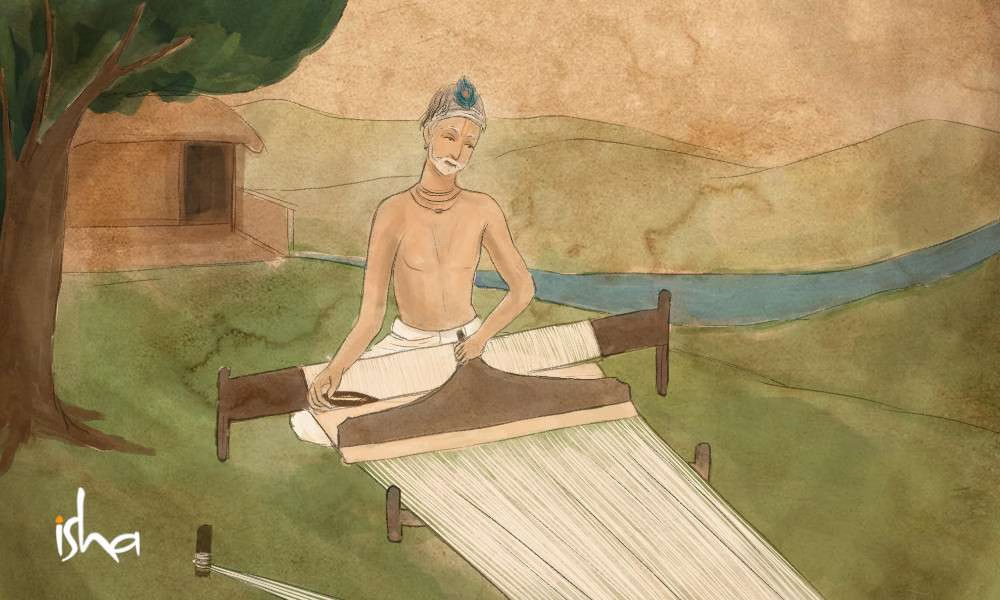
The Urgency of Liberation: Kabir's Call to Break the Bonds of Life
In the poignant words of Kabir, "If your bonds be not broken whilst living, what hope of deliverance in death?" he implores us to confront the chains that bind us in our earthly existence. This quote resonates with a profound urgency, urging us to seek liberation from the attachments and illusions that tether our spirits. The stakes are high; without addressing these bonds in life, the hope for liberation in death remains a distant dream, perhaps even an unattainable one. Kabir's wisdom invites us to reflect on the nature of our existence and the spiritual work we must undertake while we still have the breath of life.
Delving deeper, we recognize that Kabir's message is not merely a cautionary tale but a clarion call to action. The urgency embedded in his words reflects a deep understanding of the human condition, where distractions and attachments often cloud our path to spiritual awakening. To break these bonds is to engage in a transformative process that requires introspection, courage, and commitment. Kabir's teachings challenge us to examine our lives critically, to discern what truly binds us, and to strive for a state of liberation that transcends the physical realm.
The image / the metaphor
At the heart of Kabir's quote lies a vivid metaphor of bondage and liberation. The "bonds" he refers to can be understood as the myriad attachments we form throughout our lives—attachments to material possessions, relationships, and even our own identities. The imagery evokes a sense of confinement, suggesting that these bonds can suffocate the spirit and inhibit our true potential. The verbs "broken" and "deliverance" imply an active process; liberation is not a passive state but a dynamic journey that requires effort and intention.
Going deeper, the metaphor of breaking bonds can also be seen as a call to transcend the ego. In many spiritual traditions, including Kabir's bhakti path, the ego is viewed as a significant barrier to experiencing divine love and unity. By breaking free from the confines of the self, we open ourselves to a greater reality, one that is interconnected and boundless. This liberation is not merely about personal freedom; it is about realizing our place within the larger tapestry of existence, where the individual self dissolves into the universal spirit.
In the speaker's tradition
Kabir's teachings are deeply rooted in the bhakti tradition, which emphasizes devotion and love for the divine as a means to attain liberation. Central to this tradition is the concept of bhakti itself, which encourages a heartfelt connection with the divine, transcending the limitations of the ego. Kabir's insistence on breaking bonds while living aligns with the idea of kenosis, or self-emptying, where one relinquishes attachments to experience the fullness of divine presence. This journey towards liberation is not merely a personal endeavor but a collective awakening to the interconnectedness of all beings.
In the context of Kabir's work, we can draw parallels to the concept of sunyata, or emptiness, found in Buddhist philosophy. Just as sunyata invites practitioners to recognize the impermanence of all things, Kabir's call to break bonds encourages us to see through the illusions that bind us. In his poem "The Song of the Weaver," Kabir speaks of the divine thread that weaves through all existence, reminding us that liberation is found in recognizing our unity with the cosmos. This interconnectedness is a vital aspect of the bhakti path, where the individual soul seeks to merge with the divine source.
Living the teaching
Consider a modern scenario where this teaching resonates: an individual caught in the relentless pursuit of career success, sacrificing personal relationships and inner peace in the process. This person may find themselves climbing the corporate ladder, yet feeling increasingly isolated and unfulfilled. Kabir's wisdom serves as a reminder that without breaking the bonds of ambition and attachment to status, true liberation remains elusive. The urgency of his message compels us to reassess our priorities and to seek a more balanced approach to life that honors both our aspirations and our connections with others.
In another context, think of a relationship strained by unspoken expectations and unresolved conflicts. Here, Kabir's call to break bonds can be interpreted as an invitation to engage in honest communication and vulnerability. By addressing the underlying issues and releasing the need for control or perfection, both partners can experience a form of liberation that fosters deeper intimacy and understanding. This practice of breaking bonds in relationships not only enhances personal connections but also aligns with the broader spiritual journey of recognizing our shared humanity.
A reflection
As we contemplate Kabir's profound words, we are left with a contemplative question: What bonds in my life require breaking in order to experience true liberation? This inquiry invites us to reflect on our attachments, fears, and the illusions that may be holding us back. By engaging with this question, we open ourselves to the possibility of transformation, allowing the light of awareness to illuminate the path toward freedom and connection with the divine.



Join the BrightStar Community
Stay connected with daily inspiration, event announcements, and community wisdom