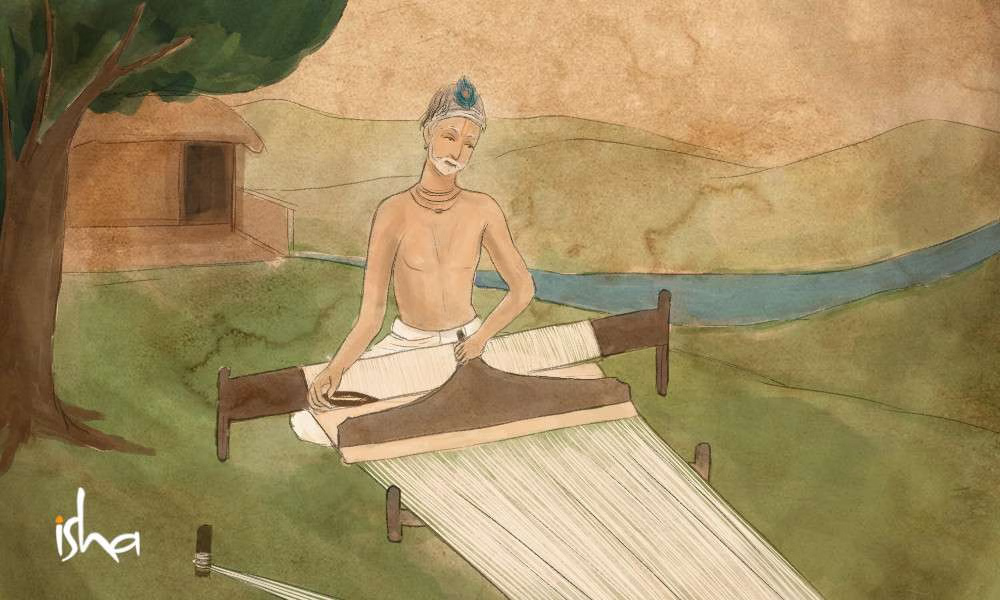
Beyond Words: The Vision of Kabir
In the profound words of Kabir, "The Purana and the Koran are mere words; lifting up the curtain, I have seen." Here, he invites us to look beyond the sacred texts that often serve as the foundation of spiritual understanding. Kabir's assertion challenges us to seek direct experience rather than becoming ensnared in the limitations of language and doctrine. This matters deeply in a world where interpretations can obscure the essence of truth, urging us to cultivate a personal relationship with the divine that transcends mere words.
As we delve into this quote, we recognize that Kabir is not dismissing the value of scripture; rather, he is emphasizing the importance of direct experience in spiritual awakening. The "curtain" he refers to symbolizes the veil that separates us from a deeper understanding of reality. By lifting this curtain, we are invited to engage with the divine presence directly, fostering a connection that is immediate and transformative. This perspective resonates with the essence of bhakti, where devotion is not merely an intellectual exercise but a heartfelt communion with the divine.
The image / the metaphor
The imagery in Kabir's quote is striking, evoking a sense of revelation and awakening. The "curtain" serves as a metaphor for the barriers that obscure our vision of truth, suggesting that what lies beyond is not only accessible but also profoundly enlightening. The act of "lifting up" implies an active engagement, a willingness to move beyond passive consumption of spiritual teachings to a more dynamic exploration of one's own experience. This imagery invites us to consider what it means to truly "see" — to perceive the divine in the everyday and the ordinary.
Diving deeper into the metaphor, we find that the act of seeing is not merely about visual perception; it encompasses a holistic understanding that integrates the heart, mind, and spirit. Kabir's assertion encourages us to cultivate a discerning eye, one that can penetrate the surface of words and concepts to grasp the underlying truths they point toward. This vision is akin to the spiritual insight found in various traditions, where the ultimate goal is to experience the essence of reality rather than to be confined by its representations.
In the speaker's tradition
Kabir's teachings are deeply rooted in the bhakti tradition, which emphasizes personal devotion and direct experience of the divine. Concepts such as dharma, or righteous living, and bhakti, the path of love and devotion, are central to his philosophy. In this context, Kabir's call to lift the curtain resonates with the idea of kenosis, the self-emptying that allows for a fuller reception of divine grace. This self-emptying is essential for experiencing the fullness of life and the divine presence that permeates all existence.
Moreover, Kabir's insights can be compared to the Buddhist concept of sunyata, or emptiness, which invites practitioners to see beyond the illusions of the material world. Just as sunyata encourages a letting go of attachments to concepts and forms, Kabir's message implores us to transcend the limitations of scripture and doctrine. In both cases, the emphasis is on direct experience as the gateway to understanding the nature of reality and our place within it.
Living the teaching
Consider a modern scenario where this teaching might resonate: a person attending a religious service, surrounded by the familiar rituals and recitations. While the words spoken may hold historical and cultural significance, they may also feel distant or disconnected from the individual's personal experience of the divine. Kabir's teaching invites this individual to lift the curtain of expectation and tradition, encouraging them to seek a more intimate connection with the divine that transcends the confines of the service. This could manifest as a moment of quiet reflection, a spontaneous prayer, or simply a deep breath that opens the heart to the presence of the sacred.
In another context, imagine a relationship where one partner feels unheard or misunderstood. The words exchanged may be laden with meaning, yet they fail to convey the depth of emotion and connection that exists beneath the surface. Here, Kabir's wisdom serves as a reminder to look beyond the spoken language and to engage in a deeper, more authentic way. By lifting the curtain of assumptions and expectations, both partners can cultivate a space for genuine understanding and connection, allowing love to flourish in its truest form.
A reflection
As we contemplate Kabir's profound statement, we are invited to reflect on our own relationship with words and experience. Are there areas in our lives where we rely too heavily on external teachings or doctrines, potentially obscuring our direct connection with the divine? In what ways can we lift the curtain to see more clearly, embracing the immediacy of our experiences as pathways to deeper understanding? This contemplation encourages us to explore the spaces between words, seeking the essence of truth that lies beyond.



Join the BrightStar Community
Stay connected with daily inspiration, event announcements, and community wisdom